The Concord Community Club: From Closed RSL to Cultural Landmark
Most club redevelopments start with an ageing building that needs freshening up. The Concord Community Club started with something different: a community that had outgrown its home and an empty building with the bones to match their ambition.
The Croatian Club Sydney — one of Australia's oldest Croatian community organisations, founded in Surry Hills in 1951 — had been operating out of Punchbowl since 1983. The venue served its purpose, but it was never going to be the long-term answer. When the former Concord RSL Club at 1 Nullawarra Avenue became available, the board saw a chance to do something far more ambitious.
What they delivered is one of the more impressive club redevelopments Sydney has seen in recent years. Not because of its budget or scale alone, but because the vision was clear from the start and the execution matched it.
The vision: a permanent home
The Croatian Club's history is one of constant movement. Surry Hills to Marrickville in 1972. Marrickville to Punchbowl in 1983. Each move brought growth, but none delivered permanence.
When the Concord RSL site came onto the market, the board — led by President Zvonimir Kurtovic and Vice-President Mijo Rimac — recognised it as more than just a property acquisition. Concord sits in the geographic heart of Sydney, close to the Parramatta River, with strong transport links and an established local community of its own. The site offered enough space to build a venue that could serve the Croatian community for generations while also becoming a genuine asset for the wider Concord and Canada Bay area.
The brief was not to renovate the old RSL. It was to reimagine it entirely: a venue capable of hosting over 2,000 guests that would express Croatian culture and heritage through architecture, materials, and attention to detail, while remaining welcoming and accessible to the broader community.
The people behind the project
Club President Zvonimir Kurtovic was one of the primary drivers behind the move from Punchbowl. He led the project alongside Mijo Rimac, who coordinated the build and is now Club President. Craig O'Brien is CEO and Secretary, overseeing day-to-day operations and the transition into the new venue.
The depth of personal investment from the board and the broader Croatian community is what sets this project apart. This was not a transaction managed at arm's length. Volunteers, sponsors, and community members contributed alongside the professional team. That level of collective ownership is rare in club projects, and it shows in the finished product.
Planning and approvals
The redevelopment proceeded under Development Application DA 2022/0223, approved by the City of Canada Bay Council for the refurbishment and extension of the club premises.
Any club board considering a similar acquisition-and-refurbishment path should be aware of the regulatory layers involved. Beyond the standard DA process, the club needed to establish a new liquor licence (LIQC330019641, operational from 23 May 2023), complete a Local Impact Assessment for Liquor & Gaming NSW, and develop a Gaming Plan of Management, all before opening the doors.
The licensing and regulatory work ran in parallel with the design and construction programme. That kind of coordination doesn't happen by accident. It requires a clear project timeline with regulatory milestones mapped alongside the build schedule.
The design: Croatian soul, contemporary execution
Altis Architecture designed the redevelopment, and it is one of the better examples of culturally informed club design you will find in Sydney.
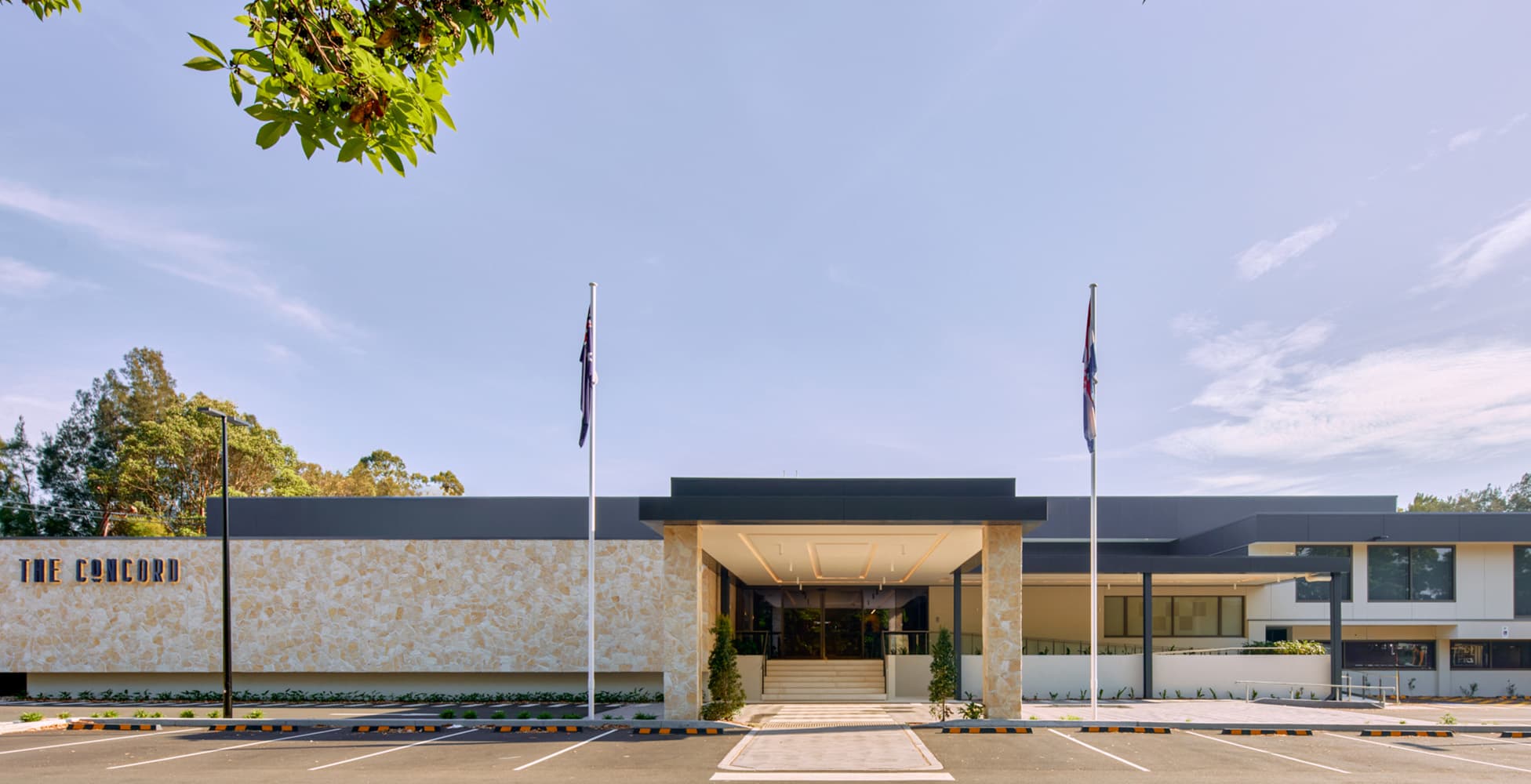
The exterior sets the tone immediately. Natural sandstone cladding wraps the facade — a direct reference to the Croatian Dalmatian coast. The covered portico at the main entry is generous and welcoming, flanked by flags and landscaping that give the building civic presence without being ostentatious.
Inside, the design moves between distinct precincts, each with its own character but connected by a consistent material language of stone, warm timber, and patterned tile.
The Piazza -- the main bar and dining area is anchored by a large marble-topped bar with leather upholstery and underlit detailing. Above, exposed timber trusses and skylights bring natural light into the space. The blue-and-white checkerboard floor tiles are a nod to the Croatian sahovnica (checkerboard), a national symbol worked into the design rather than applied as decoration. It is the kind of detail that means something to the community without confusing visitors who do not know the reference.
The Lounge Bar -- a darker, more intimate space with timber panelling, deep burgundy velvet seating, and a fluted timber bar front. Hanging greenery and decorative lighting give it warmth. This room is for a different mood: quieter conversations, after-dinner drinks, a members' retreat.
The Outdoor Dining Terrace -- a covered alfresco area with bistro-style rattan chairs in red, blue, and natural tones, festoon lighting, stone-clad counters, and timber-framed roofing with operable skylights. It connects to the piazza bar and creates an indoor-outdoor flow that makes the venue feel significantly larger than its footprint.
The Open Kitchen -- featuring a Forni Valoriani wood-fired pizza oven and an exposed commercial grill, the kitchen puts food production on display. Copper pendant lights and stonework give it a Mediterranean village feel. Visible kitchens build trust and create theatre, and this one does both well.
Throughout the venue, Croatian heritage appears in layered, considered ways. Historical city names are engraved on walls. Stonework references Dalmatian building traditions. Arched openings and shuttered windows evoke Mediterranean streetscapes. Even the amenities, with backlit oval mirrors, marble-topped vanities, and brass fixtures, carry the same level of finish.
As Kurtovic noted in an interview with Vjesnik TV: "What surprises people most is the attention to detail. From the Croatian stonework to the historical city names engraved on the walls, people feel like they've stepped into a piece of Croatia."
Construction and delivery
The project involved a substantial refurbishment and extension of the existing RSL building. The club was not operating during construction — it was a closed site rather than a live refurbishment — which gave the construction team the advantage of uninterrupted access.
That's a significant difference from projects where clubs try to maintain operations during a build. A closed-site approach simplifies logistics, reduces programme risk, and typically produces a cleaner result. The trade-off, of course, is zero revenue during construction, which means the financial modelling needs to account for a full period of no income.
The Concord officially opened on 6 June 2024 with a ceremony for invited guests, followed by a public grand opening on 9 June. By all accounts, the venue was packed from day one — full to capacity on Friday, packed all day Saturday, and a sold-out 300-person event on Saturday night.
That immediate uptake suggests the board got the market positioning right. The venue was not built only for the existing Croatian community. It was designed to attract a broader audience, and the early response confirms that strategy is working.
The project team
| Role | Firm / Individual |
|---|---|
| Architect | Altis Architecture |
| Client | The Croatian Club Ltd |
| Club President (during build) | Zvonimir Kurtovic |
| Current President | Mijo Rimac |
| CEO / Secretary | Craig O'Brien |
| Location | 1 Nullawarra Avenue, Concord NSW 2137 |
| Council | City of Canada Bay |
| DA Reference | DA 2022/0223 |
What boards can take away
The Concord Community Club is a different kind of club redevelopment story. It is not a staged refurbishment of an existing venue. It is an acquisition and transformation: a community that bought a building with history and made it their own.
There are several lessons here for boards considering a similar path:
-
Cultural identity can drive design excellence. The Croatian heritage was not an afterthought bolted onto a generic club fitout. It informed the material choices, the spatial decisions, the details. That is what makes the venue feel authentic rather than themed. Any club with a strong community identity, whether cultural, sporting, or local, can apply the same principle.
-
Acquisition can be faster than building new. Buying and refurbishing an existing building with appropriate zoning and infrastructure can be significantly faster and less risky than a greenfield development. The existing RSL structure provided the bones; the design team provided the soul.
-
A closed-site build has real advantages. Not every club can afford to shut down during construction, but when the financials support it, the benefits to programme, quality, and safety are substantial.
-
Community investment matters. The level of volunteer and sponsor involvement in this project was exceptional. When your community is personally invested in the outcome, it shows in the build, the opening, and the long-term patronage.
-
Get the regulatory work done early. Liquor licensing, gaming approvals, and local impact assessments all take time. Running them in parallel with design and construction requires planning, but it avoids costly delays at the end.
Where the club sits now
The Concord is now the largest Croatian social club in Australia and a genuine community destination in Sydney's inner west. The venue hosts cultural events, live entertainment, family dining, and private functions, a mix that keeps the rooms full across different demographics and times of week.
For us at UpScale, projects like this show what is possible when a board has a clear vision and the right team around them. We are currently working on the Granville Diggers Club redevelopment, which shares some of the same DNA: a community club with a proud history investing in its future through a well-planned redevelopment.
If your club is thinking about a redevelopment, acquisition, or major refurbishment, get in touch. We help boards navigate the full process — from feasibility and planning through to construction delivery.
Director, UpScale Project Management
Architect-turned-project manager with experience across government infrastructure, commercial, and hospitality sectors. Noel founded UpScale PM to provide independent, client-side advisory for club boards navigating major redevelopment projects across NSW.